 Event wrap
A day of AI adoption stories
aiblLIVE
London 2026
Seven sessions. One theme. The tools were never the hard part.

The one theme
AI adoption is a people problem wearing a technology costume
aiblLIVE London 2026 filled Convene Sancroft, with over 900 business leaders and AI enablers. This is my pick of the seven sessions I sat in. Across every one, speakers kept returning to the same four ideas.
Write your knowledge down
Fix your data
Measure trust
Build talent alongside the pilot
The through-line
The tools were never the hard part.
Every operator who had actually shipped something said a version of the same thing. The model was the easy bit. The people were the work.

Session 1 · Workforce track · Rollout, knowledge and skills
How YuLife got 94% of its people using AI
Jonathan Roomer Co-Founder, Applied AI & Giles Boon-Williams Principal Engineer, YuLife
Agents are a destination, not a starting point. Capability, confidence and trust come first.
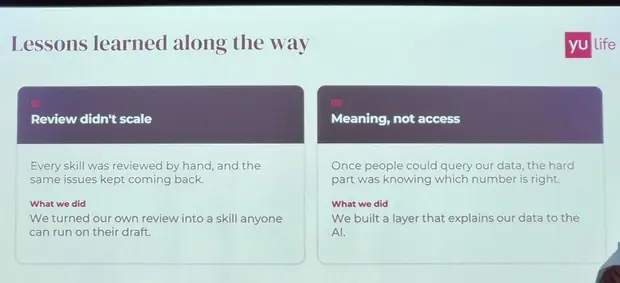
- Sponsorship with a purpose. Execs set three goals early: accelerate business outcomes, not cost-cutting, unlock knowledge, and make people powerful.
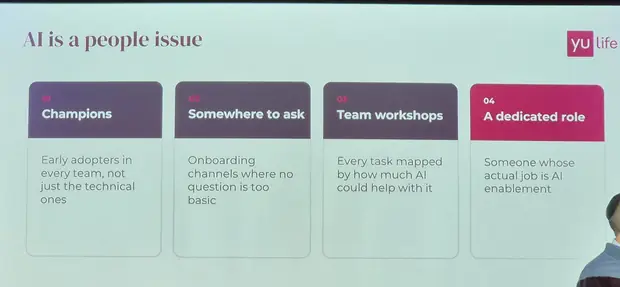
- Champions, not mandates. Champions were recruited in every team, especially non-technical ones. Each got a 1:1, and team Slack channels ran on "no question too basic."
- AI is only as good as what you have written down. Knowledge moved into markdown files surfaced through Gitbook, readable by people and machines. Less, better content beats a pile of transcripts.
Worth stealing: anyone can build a skill. Engineering reviews for standards rather than blocking, and wrote its own review judgement down as a reviewer skill.
Still unanswered
- Where is the front door? Who owns governance when everyone can build, and how do you inventory it all?
- Who are our champions in non-technical teams?
- Are we splitting efficiency gains, or just adding workload?
Session 2 · AI Infrastructure track · Interactive workshop with a live assessment
AI transformation with Notion: build the context for AI to succeed
Laura Gregg Head of UK & Ireland Sales & Tashan Dunbar Enterprise Solutions Consultant, Notion
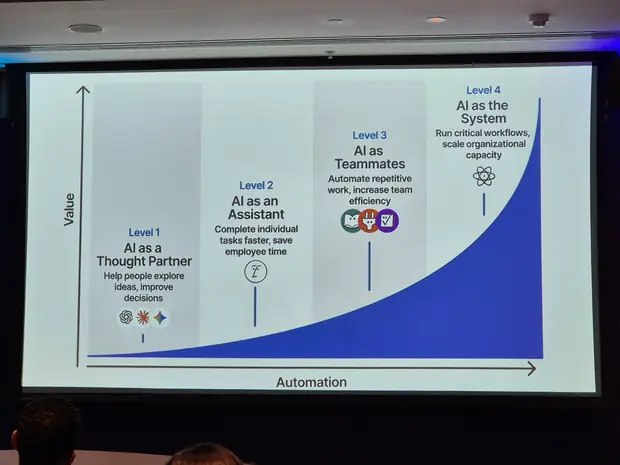
Context is the foundation. The more connected your data, the smarter your AI.
Thought partner
Explore ideas.
Assistant
Finish tasks faster.
Teammates
Automate repetitive work.
The system
Critical workflows run on AI.
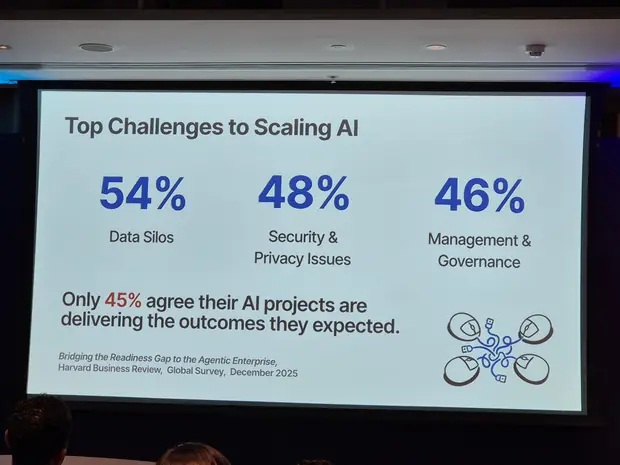
Most organisations reach Level 1 or 2 quickly. The Level 4 companies typically started their foundations 12 months earlier. When the room voted it skewed Level 3, with a small cluster at Level 4. What holds people back: data silos, security and privacy gates, unclear ownership of AI tools, and wins stuck with power users while the other 80% stay underserved.
The demo that landed: the Level 4 build (Lumiglow) ran from Zendesk, Slack and Jira intake to a PRD, then code review and a GitHub deploy, with a human review at each stage.
Ask yourself
- Which level are we really at, and which dimension is dragging us?
- Does our AI inherit our permissions, or bypass them?
- What are the three to five high-volume workflows we could measure first?
Session 3 · Workforce track · From AI investment to AI impact
The digital skills gap
Holly Chate Chief Operating Officer, FutureDotNow
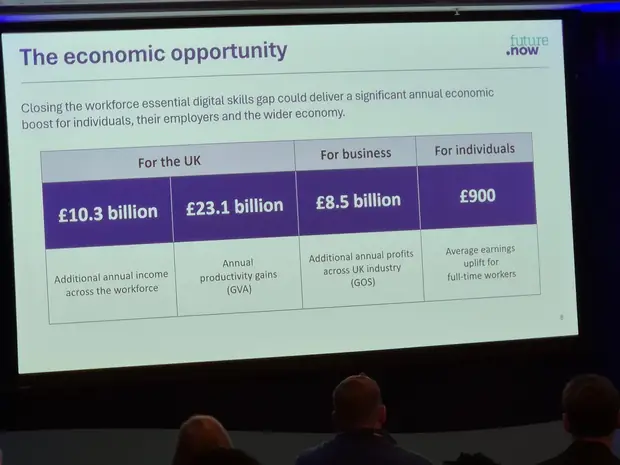
Workforce capability is the missing link. Most employers know how many licences they bought, but not what their people can actually do.
- The gap is wider than you think. One in four tech-sector workers lack all the essential digital skills. So do one in three people earning over £75k.
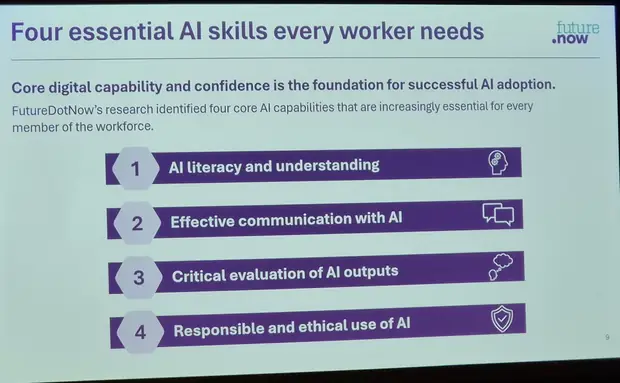
- The AI risk is not the prompt. It is whether people can use AI safely, critically and responsibly. Four skills were defined: understand it, communicate with it, evaluate its outputs, and use it responsibly.
- Motivation is a barrier. A self-assessment of everyday tasks left 90% of those who completed it feeling more motivated.
Ask yourself
- Do we know what our workforce can actually do, or only what we have bought?
- Are we measuring confidence as well as access?
Session 4 · Architecting an outcome
But my org wasn't built for AI: Sullivan & Stanley's three-question test
Andy Haley CEO, Sullivan & Stanley
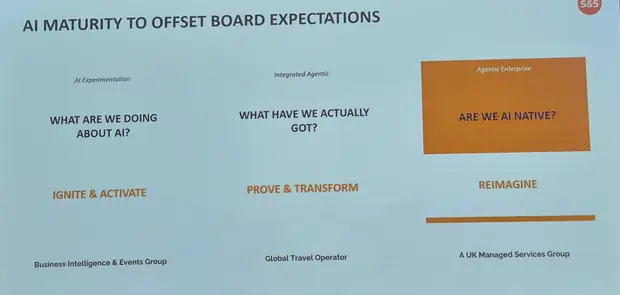
Every leader has one foot in the present and one in the future. Legacy is not just technology. It is tools, mindsets, skills, culture, people and data.
- Three questions before you start. Are the outcomes coherent? Do you understand the variables? Can you influence them? Change is a vector, not a scalar, so conflicting programmes can cancel each other out.
- Pilots are easy. Enterprise AI at scale is the hard part nobody has cracked. Agents create second, third and fourth-order effects that are hard to track.
- Start the talent strategy with the pilot. Embedding one at board level takes a year or more. A Chief AI Officer in an unchanged boardroom is not a solution.
The talent quadrant
Human judgment on one axis, AI fluency on the other. The goal is high on both.
High fluency, low judgment
The "AI crutch generation"High judgment, low fluency
The "wise traditionalist"The line that got attention: token pricing is opaque and disconnected from the work done.
Ask yourself
- Are our outcomes coherent, and can we influence the variables?
- Who is the human intelligence lead alongside the AI lead?
- If AI removes the chance to make mistakes, how will juniors build judgment?
Session 5 · AI Infrastructure track · Real estate, data hygiene and culture
The unglamorous half of AI: data, CRM and governance at Battersea Power Station
Alton Hassan Former Digital Solutions Director, Battersea Power Station
Digital transformation is a culture problem first and a technology problem second.
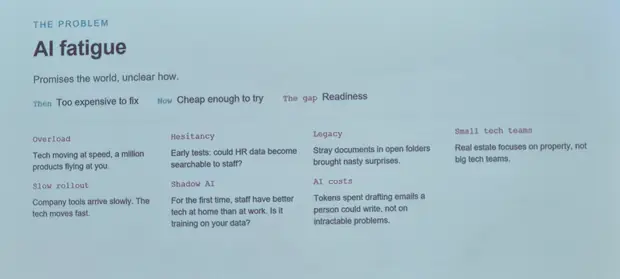
- Fix the data before the rollout. Early tests surfaced HR data, salary information and CEO pay from inconsistently saved documents.
- Shadow AI arrives before your policy does. Staff uploaded contracts to public LLMs. A slow policy rollout drove unsanctioned use.
- Run "therapy sessions." Teams like finance and legal described everyday problems, not technology solutions. That surfaced the long-ignored "too difficult" ones.
Worth stealing: point AI at intractable problems, not email writing. Build model-agnostic, because a model update can break a working setup. Explain the business reason behind compliance, not just the obligation.
Ask yourself
- What would an AI find if it searched our shared drives today?
- What is the "too difficult" problem our teams have stopped mentioning?
- Can we switch models without rebuilding?
Session 6 · Workforce track · Raising the floor and the ceiling
Beyond the forecast: why AI adoption at the Met Office was a change management problem
Kirstine Dale Chief AI Officer, Met Office
"Change starts and ends with people." AI is a tool for the mission, not the outcome.
The moment everything changed. Physics-based forecasting had been in use for about 60 years. Then Christmas 2022 brought multiple new AI weather models at once. Internal questions followed: why have the supercomputer, the physicists, or a Met Office at all?
The two-track response. Raise the ceiling: focused teams worked on breakthrough science with the Alan Turing Institute and built Fastnet, an experimental AI-based global forecast. Raise the floor: an "AI for Everyone" change programme ran training, surgeries, hackathons and an annual showcase day, with guardrails and governance.
Why physics still matters. It provides the training data. Safety-critical decisions need explainability. Climate change means old data no longer represents future conditions. The future is a hybrid model.
Framed with Amara's Law and the Gartner Hype Cycle. Christmas 2022 was the peak of inflated expectations. The workforce moved from worried about job loss, to confident, to curious and excited.
Ask yourself
- Are we working on both the ceiling and the floor?
- What do our "old methods" still do that AI can't?
- Where are we on the hype cycle?
Session 7 · Workforce track · Fear, trust and the bad day
Building responsible AI at the British Red Cross
Simon Hodgkinson AI Product Owner, British Red Cross
Adoption is not the licence, it is the bad day. Real adoption is whether someone reaches for AI under pressure, unwatched and unsure.
Simon was asked to find use cases. He built a literacy programme instead. About 2,000 of roughly 4,000 staff now use Copilot daily, and staff brought their own use cases within six months.
Then the pilot that went quiet. A frontline case-note tool had backing, training and strong early usage. From week six, usage fell, and the dashboards could not say why. The root cause was that trust was never measured.
"I don't trust it to get this person's story right, and if it gets the story wrong, that's on me. I read everything it wrote and then I rewrote it. It takes me longer now, so I stopped."
Frontline worker, as quoted in the session.
Three lessons
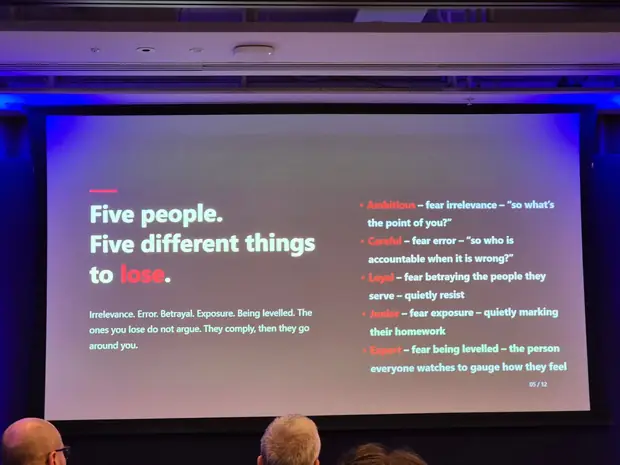
- Fear is data, not resistance. Five fear profiles turned up again and again: ambitious, careful, loyal, junior, expert.
- Measure trust, not just usage. Ask "if we turned it off tomorrow, what would you miss?" 90% compliance is weaker than 30% who would not give it back.
- Design with them, not for them. Don't automate a broken process. Governance should say what is never allowed, in plain language, and name an approachable human who is accountable.
- Ambitiousfear irrelevance, "so what's the point of you?"
- Carefulfear error, "who is accountable when it is wrong?"
- Loyalfear betraying the people they serve, so they quietly resist
- Juniorfear exposure, quietly marking their own homework
- Expertfear being levelled, the person everyone watches to gauge how to feel
The line that closed the day: write a job description for AI, as you would for a new hire, and share it so everyone knows where AI fits.
Ask yourself
- What would our people miss if we turned AI off tomorrow?
- Which fear profile is quietly stopping people on our team?
- Who is the named human accountable when AI gets it wrong?
Take it back to the office
Questions for your business
- Is our knowledge written down where people and machines can both read it?
- Are we measuring trust, or only licences and logins?
- Does our talent strategy start at the same time as our pilots?
- Is our data clean enough to point an AI at?
- Which fear profiles are in our teams, and who are the champions who can shift them?
- Are we working on both the floor, literacy for everyone, and the ceiling, breakthrough use cases?
From the floor
The day, in frames
A thousand people, seven sessions, and a lot of slides worth photographing. Tap any frame to bring it forward.
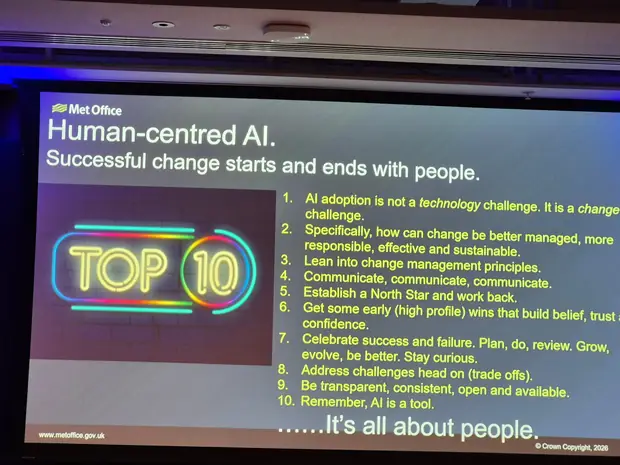
Ninety seconds of the room
Watch the reel
 aiblLIVE London 2026, the highlightsYouTube
Tap to play here, or watch it on YouTube.
Join the network
We go to these so you get the signal
POTATO is a UK-born tech network on WhatsApp: the right people, the right rooms, the right information. We show up at events like aiblLIVE and bring back the parts worth keeping. Membership is capped.
- 12+ focused channels: AI, Fintech, Healthtech, Createch, Greentech, Jobs, Policy & Legal and more
- A network that replies. Sharp people, low friction
- Event discounts that add up. Members saved £3,000+ on average last year
- POTATO events: POLATEO salons, focused meetups, summer parties
- Proper event coverage. Not a recap, an actual take
- “Farmers” in every channel keeping the quality high